For More Information about honors biology tutoring book a free consultation
DNA Replication
Before a cell divides, it has to copy all of its DNA. Here's how DNA replication works and why getting it right matters so much.
TOPICS
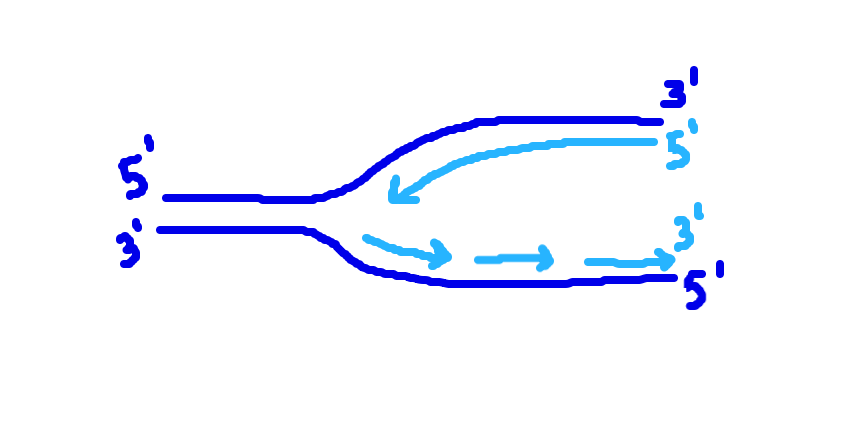
DNA Replication: Understanding the Direction Problem
DNA replication ranks among the most conceptually challenging topics in honors biology. Students often grasp that DNA unzips and each strand serves as a template, but then it becomes at little more confusing with the details: leading strand, lagging strand, Okazaki fragments.
The core issue? DNA polymerase can only build in one direction, but the two template strands run in opposite directions.
Why This Matters
When the replication fork opens, one template strand runs 3' to 5' (perfect for continuous synthesis), while the other runs 5' to 3' (problematic for DNA polymerase). This directional constraint is what creates the need for the discontinuous building of the lagging strand.
Making Sense of It
The leading strand is straightforward: DNA polymerase builds continuously as the fork opens.
The lagging strand requires a different strategy. Since the template runs the "wrong" way, DNA polymerase must work in short segments called Okazaki fragments, essentially building backward in pieces. DNA ligase then connects these fragments.
The Key Insight
DNA replication isn't confusing because the process is arbitrary—it's confusing because there's a real directional constraint that cells must work around. Once you understand why the leading and lagging strands differ, the mechanism makes sense.
If DNA replication (or any molecular biology topic) isn't clicking yet, I offer online tutoring to help clarify these processes
© 2026. All rights reserved.